
Salvatore Esposito
Researcher & Engineer
University of Edinburgh
I'm a researcher and engineer working on autonomous robot navigation, 3D Vision, and Generative AI, currently on foundation models and SLAM. I spent two years at the Microsoft Mixed Reality Lab working on 3D reconstruction and Generative AI for HoloLens and Microsoft Teams. I have also worked on systems infrastructure at Huawei and quantitative research at American Express.
Interests
Education
-
PhD in Geometric Deep Learning (Biomedical AI CDT) University of Edinburgh
-
MRes in Artificial Intelligence University of Edinburgh
Professional Experience

Postdoctoral Research Fellow
University of Edinburgh
2025 – Present
Edinburgh
Postdoctoral Research Fellow in Autonomous Robotics Surgery
- Making minimally invasive surgery more precise and safer, by developing the SLAM and 3D mapping a robot needs to navigate inside the body
- Built ROOM, the physics-based simulator that generates the training data this work depends on

Research & Development
Microsoft
2022 – 2024
Zurich & Cambridge
Visiting Researcher, Zurich (2022–2024)
- Improved the avatars in HoloLens and Microsoft Teams, leading the rework of the HMR 2.0 multimodal transformer pipeline
- Made avatars move and sound more like the people driving them, by sharpening motion and audio prediction
Research Intern, Cambridge (2022)
- Produced 3D meshes clean enough to use downstream, with GAN- and NeRF-based generative models; Microsoft released the work as GeoGen
- Turned noisy renders into high-quality facial meshes, with a neural rendering architecture I designed

Research Intern
Huawei
2023
Edinburgh
Systems Infrastructure Research
- Made it possible to size virtual machine fleets to real demand, forecasting CPU utilization with time-series models
- Designed resource management that allocates capacity ahead of demand
Research Intern, Cambridge (2022)
- Improved NeRF rendering quality by integrating it with caching

Quantitative Researcher
American Express
2022
London
Quantitative Analysis
- Built the financial models behind large-scale analysis, using machine learning and statistical methods
- Made that analysis run faster, by optimizing its HPC and cloud pipelines
Publications
* Equal contribution
Under Review
3D Reconstruction of Endoluminal Lung Anatomy from Monocular Vision
Under review, 2026
MICCAI 2025
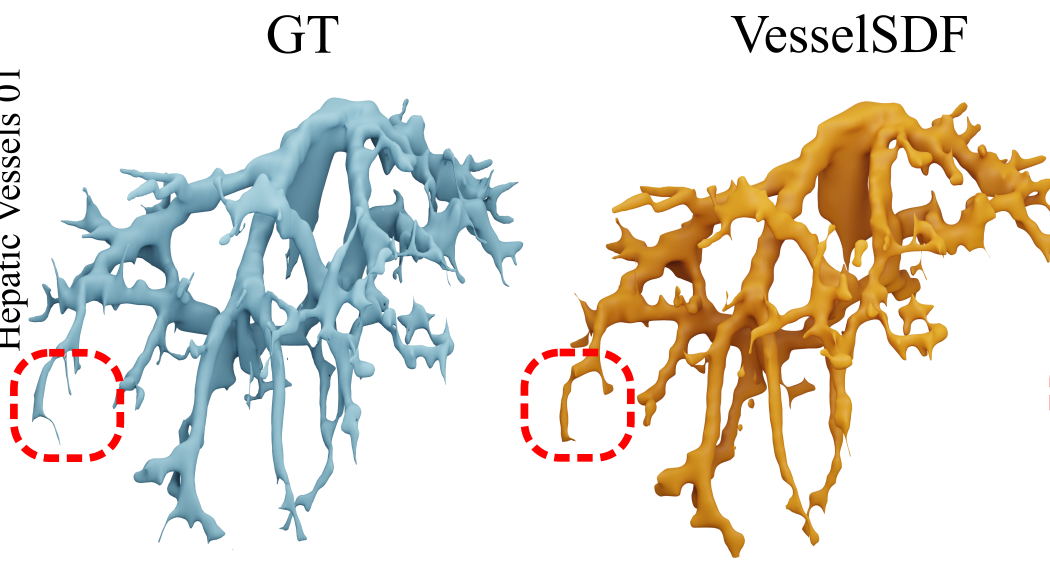
VesselSDF: Distance Field Priors for Vascular Network Reconstruction
International Conference on Medical Image Computing and Computer Assisted Intervention (MICCAI), 2025
Awards
CDT Doctoral Scholarship in Biomedical AI
UKRI
2020
Contact Me
Working on something in robotics, 3D vision, or generative AI? Get in touch.